A poach is when you cross into your partner's side of the court to take a ball that was headed for them. It's legal, it can end a rally fast, and it works best when your partner is back and you are at the kitchen line. Done at the wrong moment, it takes a shot from your partner and leaves a big gap. This guide covers when to go, when to stay, and how to agree on it. It sits with our other strategy guides, so keep reading when you are done.
What is poaching in pickleball?
Poaching happens when a player reads where a shot is going, then moves in to take it instead of leaving it for their partner. It is a doubles move only. In singles there is no partner to cross over to.
A good poach is planned, not a lunge. You see the ball coming, you decide early, and you move before the opponent even hits. A late, half-committed move is how partners collide or leave the ball between them.
Poaching is not against the rules. Apart from the server, players may stand anywhere on their own side of the net. What limits you is the same as always: the kitchen rule and the two-bounce rule still apply, and your partner still has to cover what you leave open.
There's a quiet side benefit. The threat of a poach can be enough to force errors. If opponents think you might cross, they hit riskier shots to avoid the middle.
When should you poach?
Most good poaches come from a few clear moments.
Your partner is back and you are at the kitchen line. This is the most reliable chance. Opponents tend to hit toward the deeper player, so you can shade toward the middle and cut the ball off.
A crosscourt dink floats. If one opponent is passive and a dink comes back higher or slower than the last one, step across and hit it down the line. A change of direction is hard to defend.
You can read the speed-up. Watch for a bigger backswing, a paddle dropping low, or weight moving forward. At the kitchen line you should expect a speed-up on every shot, so reading these cues early gives you the jump.
A pop-up comes over. Take it with placement, aiming at feet or open court. Hitting it hard at an opponent often just resets the rally.
Whichever you pick, be ready to finish. After a poach you and your partner are often on the same half of the court, so a weak poach leaves the other side wide open.
When should you not poach?
Stay put when any of these is true:
- Both of you are already set at the kitchen line. There's no big gap to exploit, and you risk crowding each other.
- The ball is dipping below net height. You will be hitting up, and the poach turns into a pop-up for the other side.
- Your partner is about to hit an attacking shot. Crossing in front of them spoils their target.
- You are guessing. If you cannot say why the ball is coming your way, leave it.
The guide on where to stand in doubles shows the setup that makes a poach possible in the first place.
What signals and calls do you need?
A poach works when your partner expects it. Two habits cover most of it.
- Agree on it before the point. Some pairs use a hand signal behind the back before the return of serve, to show you plan to take the third shot. When one of you is up and the other is back, decide in advance who takes the next ball.
- Call it. If your partner is closing in on a ball on their side, they say "mine" so you do not go for it as well. In the same way, say "yours" when you give a ball up.
Stacking is a related idea, because it also changes who is where. If you use it, read what stacking is so the two ideas do not get mixed up.
What does the kitchen rule mean for a poach?
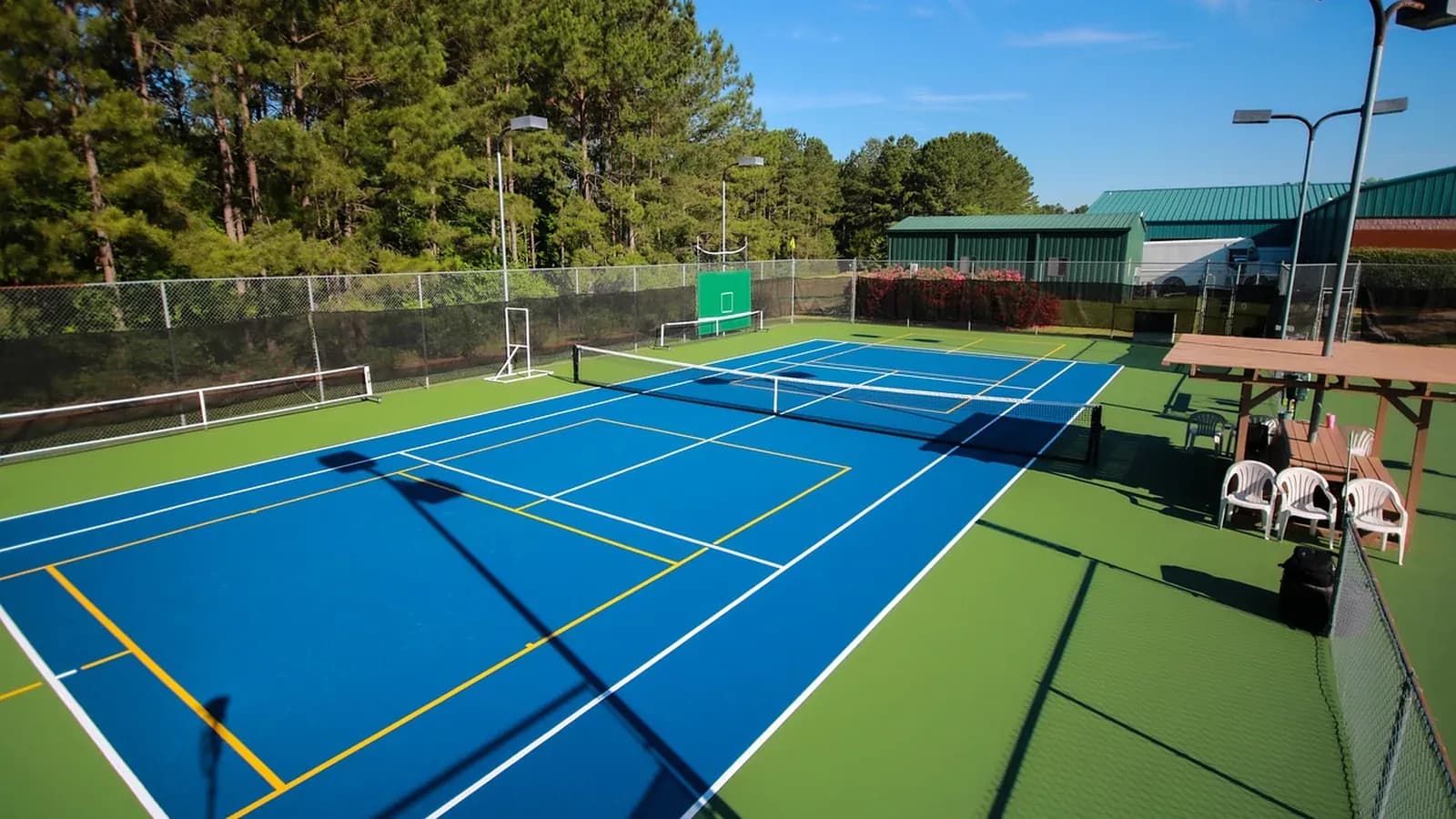
Poaching often happens near the net, so keep the kitchen rule in mind. The non-volley zone reaches 7 feet from the net. You cannot volley while standing in it or touching its lines. You may step into it to play a ball that has bounced, but both feet must be out again before you volley. Read the full rule in our guide to the kitchen rule. One more risk: if your momentum carries you into the zone after a volley, or into your partner while they stand there, that is a fault.
What happens to the score after a poach?
Nothing. The score, the server number and the serving side follow who served and who won the rally, not who hit the ball. If you cross over, take the ball and win the rally, your side just wins it, and the call stays the same.
What does change is where you stand. After a poach, your partner usually covers behind you, and you move back to your side as soon as the ball is dead. If the two of you end up in the wrong court at the start of the next serve, read how to fix a wrong server or wrong side.
Is poaching fair in rec play?
Here people disagree, and it's opinion, not rule. One coach says poaching in rec play is a selfish move because it takes shots from a partner who needs them to improve, and a miss costs you twice. The same coach is fine with it in tournament play when it is timed well and pre-signaled.
You don't have to pick a side. Ask your partner before the first game. If they like it, poach with a plan. If they would rather play their own shots, leave it and focus on staying linked.
Try it with Pickle Call
A poach does not change the call, so you should not have to stop and work out the score after one. Pickle Call keeps the call, the server number and the serving side for you with one tap per rally. Tap the side that won the rally, and the rest follows, whoever hit the ball. Pickle Call is coming to iPhone, iPad and Apple Watch. See how the score call works.
Bottom line
A poach is a planned move across the centerline to take a ball meant for your partner. Use it when your partner is back and you are at the kitchen line, when a dink floats, or when you can read the speed-up. Skip it when you are guessing. Agree on it first, call your balls, and the score takes care of itself.
Questions
- Is poaching against the rules in pickleball?
- No. Apart from the server, doubles players may stand anywhere on their own side of the net, so crossing over to take a ball is legal. The limits that still apply are the kitchen rule and the two-bounce rule. Whether it is good manners is a question for you and your partner, not the rulebook.
- Does the score or server number change when you poach?
- No. The score, the server number and the serving side follow who served and who won the rally, not who hit the ball. A poach changes where you both stand, not the call.
- Who should take the ball down the middle?
- Agree on it before the game. Many pairs give the middle to whoever has the forehand there. Whatever you choose, call mine early so you don't both go for it.
- Should I poach in casual rec play?
- Ask your partner first. Some players enjoy it, and others feel their shots are being taken. One coach calls poaching in rec play selfish, which is an opinion, not a rule. A quick check before the first game settles it.